Scenic view of a residential area in San Mateo County on lush green hills, with a clear view of a large bridge and body of water, set against distant mountains under a bright blue sky.

Equity

Guiding Principle from Strategic Plan: Equity

We work to change practices, structures, and policies to realize transportation equity for commuters in San Mateo County.

Commute.org believes that the following strategies are critical to realizing its mission and equity guiding principle. We will:  ​


  1. Develop programs and initiatives that increase equitable transportation access and diverse engagement.
  2. Foster partnerships with community organizations that connect Commute.org with historically underserved communities in the county. 
  3. Increase equitable distribution of commuter benefits and provision of services to serve low income and underserved communities.
  4. Measure progress based on qualitative and quantitative data on race/ethnicity, location, gender identity, disability, age, income, occupation, and industry type. 
  5. Build organizational capacity to operationalize diversity, equity, inclusion, and belonging into Commute.org’s management, service delivery, and culture.
  6. Work with external agency partners to improve local and regional transportation access and options.

Statement on Diversity, Equity, and Inclusion

Commute.org is committed to and accountable for advancing diversity, equity, and inclusion in all its forms. As a public agency serving a diverse community:

  • We acknowledge our past and current shortcomings around diversity and inclusion.
  • We will foster and maintain a safe environment of respect and inclusion for staff and members of the communities we serve.
  • We will educate our staff to be transportation equity advocates, creatively providing programs and environments that reflect the diversity of our community and elevate cultural awareness.
  • We will ensure fair and inclusive access to our programs, resources, and services, and ensure that our policies and practices are equitable and available to commuters at all socioeconomic levels.
  • We will advance and build our staff by assessing hiring practices and performance review procedures to attract, retain, and develop talented staff from diverse backgrounds.

Data

  • Introduction to Data
  • Commuter Patterns
  • Demographics
  • Industry Data
  • Introduction to Data

    Background

    Integrating equity principles across all programs is one of Commute.org’s strategic objectives for the 2025 Strategic Plan. The agency uses this data to better understand where the gaps are in services.

    Unique Considerations

    Commute.org focuses on people who live OR work in San Mateo County. 

    Much of the information that we have is from the US Census for residents of San Mateo County. It is more difficult to find demographic data for people who live outside the county and commute in. 

    In addition, much of the data for Commute.org’s programs is based on survey responses, so it is only a slice of the total people that the agency serves and is not comprehensive.

  • Commuter Patterns

    Commute Patterns

    There are almost 400,000 people who work in San Mateo County.
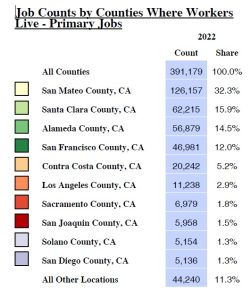
    Top 10 Counties Commuting to SMC (2022):

    Bar chart titled "Job Counts by Counties Where Workers Live - Primary Jobs" for 2022. Lists counties with job counts and share percentages: Santa Clara, San Mateo, Alameda, San Francisco, Contra Costa, others. Total: 391,179 jobs.


    Source: US Census

    Bar chart showing percentages of commuters to SMC for 2019, 2021, and 2022. Categories: "Live and work in SMC," "Live in SMC and work outside," and "Work in SMC and live outside." Displays shifts in commuter trends over the years.

    Source: US Census

    Bar chart titled "Commuters to SMC" shows data from 2019, 2021, and 2022. Categories: "Live in the Bay Area," "Live within 25 miles," "Live greater than 50 miles away." Percentages: Bay Area: 81%, 83%, 81%; 25 miles: 72%, 69%, 68.6%; 50 miles: 14%, 16%, 17.3%.

    Source: US Census

    Commute.org Program Participants – Home City:

    Bar chart titled "Top Home Cities for CommuteStar Users 1/2025" displaying percentages of users from various cities. San Francisco leads with approximately 15%, followed by Seattle. Other cities include New York, Boston, and Austin with decreasing user percentages.

    Shuttle Survey – Home City:

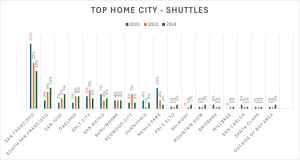
    Bar chart titled "Top Home City - Shuttles" shows data for 2021, 2022, and 2024 across various cities. San Francisco and South San Francisco have the highest bars with significant increases, while other cities have lower percentages.

    Commute.org Program Participants – Work City:

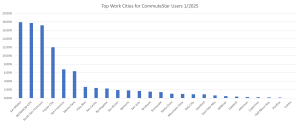
    Bar chart titled "Top Work Cities for CommuteStar Users 1/2025" showing the percentage of users by city. Salt Lake tops at nearly 18%, followed by Boston, San Francisco, Seattle, and New York, which all have lower percentages.


  • Demographics

    Demographic Key Findings

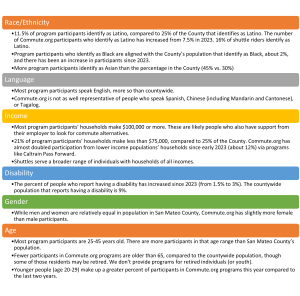
    Flowchart depicting determinants of health, starting with Race/Ethnicity, Language, and Income; Disability and Gender leading to Health Care Access; and Age, Income, and Access leading to Health Status, influencing Biological/Genetic Factors.

    Profile of Workers in San Mateo County

    Source: US Census, 2021

    A data table shows employment statistics. Categories: Worker Age, Worker Sex, Worker Race, Worker Ethnicity, Earnings, Educational Attainment. Each category lists subcategories with respective counts and percentages.

    Source: US Census, 2022

    Bar chart titled "Race and Ethnic Background" showing percentage estimates from the 2015-2019 ACS and STAR Demographic Surveys of 2021 and 2024 for various racial and ethnic groups, including Asian, Black, Hispanic, and White.

    ACS has a separate questions for Hispanic, Latino, or Spanish origin versus Race. Commute.org combines this into one question in which people can select multiple/all that apply.
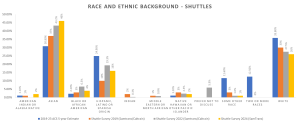
    Bar chart titled "Race and Ethnic Background - Shuttles" displays percentages for different racial groups across four surveys from 2019 to 2023. Categories include American Indian, Asian, Black, Hispanic, White, etc., each represented by colored bars.

    Bar chart titled "Income" comparing income distribution in different ranges across three surveys from 2023 to 2025. The chart shows varying percentages for each range, with green, blue, and yellow bars representing different years.

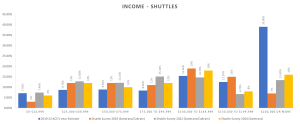
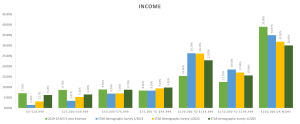
    Bar chart titled "Income - Shuttles" showing income distribution across five categories for different surveys. Categories range from $0–$14,999 to $200,000 or more, with data from ACS (2019), Shuttle Survey (2019, 2022, 2024).

    Bar graph titled "Language" displaying usage percentages from 2019 to 2025. English is the highest, followed by Spanish, Chinese, and others. Different colored bars represent estimates and surveys from various years.

    ACS: English = those who speak only English and those who speak other languages and speak English very well

    CommuteStar Demographic Survey Data includes people who speak one or more language, each language counted once
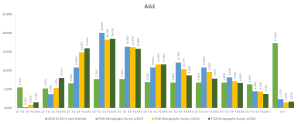
    Bar chart titled "AGE" shows age distribution estimates from 2019 to 2025. Categories range from "1.5 TO 9 YEARS" to "65+." Each group compares data from ACS and STAR surveys, represented in different colors. Percentages are marked on each bar.

    Bar chart titled "Gender Identity" comparing data from the 2019 ACS 5 Year Estimate and STAR Demographic Surveys 2023–2025. Categories include Female, Male, Non-Binary, Not Specified Above, and Prefer Not to Say. Values are given as percentages.

    ACS only offers male or female as options

    Bar chart titled "Disability" showing percentages of "Yes" and "No" for 2019 ACS Estimate, STAR Surveys from 2023, 2024, and 2025. "Yes" ranges from 10.30% to 14.90%, "No" ranges from 85.10% to 89.70%.


  • Industry Data

    Industry Data Key Findings

    A bar graph showing three categories: "San Mateo County with less than 5 employees" (orange), "Information is the #1 industry by % of employees" (gray), and "Employers" (yellow), and "Employees" (blue). Each bar varies in length.

    Bar chart comparing the number of establishments in a county versus active employers in the Commute.org database for 2022 and 2024, across various industries like professional services, real estate, transportation, and manufacturing.

    Source: 2022 ECNVY Business Patterns County Business Patterns
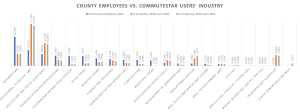
    Bar graph comparing county employees and CommuteStar users by industry for 2022 and 2023. Includes sectors like healthcare, education, retail, manufacturing, etc. with percentage values.

    Source: 2022 ECNVY Business Patterns County Business Patterns