Equity
Guiding Principle from Strategic Plan: Equity:
We work to change practices, structures, and policies to realize transportation equity for commuters in San Mateo County.
Commute.org believes that the following strategies are critical to realizing its mission and equity guiding principle. We will:
- Develop programs and initiatives that increase equitable transportation access and diverse engagement.
- Foster partnerships with community organizations that connect Commute.org with historically underserved communities in the county.
- Increase equitable distribution of commuter benefits and provision of services to serve low income and underserved communities.
- Measure progress based on qualitative and quantitative data on race/ethnicity, location, gender identity, disability, age, income, occupation, and industry type.
- Build organizational capacity to operationalize diversity, equity, inclusion, and belonging into Commute.org’s management, service delivery, and culture.
- Work with external agency partners to improve local and regional transportation access and options.
Statement on Diversity, Equity, and Inclusion
Commute.org is committed to and accountable for advancing diversity, equity, and inclusion in all its forms. As a public agency serving a diverse community:
- We acknowledge our past and current shortcomings around diversity and inclusion.
- We will foster and maintain a safe environment of respect and inclusion for staff and members of the communities we serve.
- We will educate our staff to be transportation equity advocates, creatively providing programs and environments that reflect the diversity of our community and elevate cultural awareness.
- We will ensure fair and inclusive access to our programs, resources, and services, and ensure that our policies and practices are equitable and available to commuters at all socioeconomic levels.
- We will advance and build our staff by assessing hiring practices and performance review procedures to attract, retain, and develop talented staff from diverse backgrounds.
Data
Background
Integrating equity principles across all programs is one of Commute.org’s strategic objectives from the 2025 Strategic Plan. The agency uses this data to better understand where there are service gaps.
Constraints
Commute.org focuses on people who live OR work in San Mateo County.
Much of the information that we have from the United States Census for residents of San Mateo County. It is more difficult to find demographic data for people who live outside the county and commute in.
Much of the data for Commute.org’s programs is based on survey responses, so it is only a slice of the total people that the agency serves and is not comprehensive.

Commute Patterns
There are almost 400,000 people who work in San Mateo County.
Top 10 Counties Commuting to SMC (2023):

Distance to work from home for workers in San Mateo County
Source: U.S. Census Bureau, OnTheMap Application and LEHD Origin-Destination Employment Statistics (Beginning of Quarter Employment, 2nd Quarter of 2002-2023).
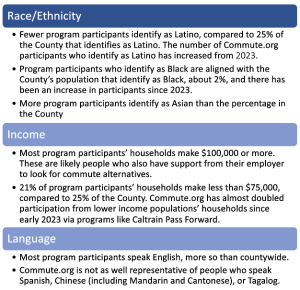
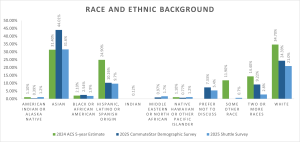
Demographic Key Findings
Source for Countywide data is the American Community Survey (ACS) 5-year estimates.
ACS has a separate questions for Hispanic, Latino, or Spanish origin versus Race. Commute.org combines this into one question in which people can select multiple/all that apply.
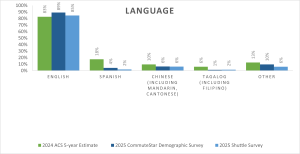
ACS: English = those who speak only English and those who speak other languages and speak English very well
CommuteStar Demographic Survey Data includes people who speak one or more language, each language counted once.
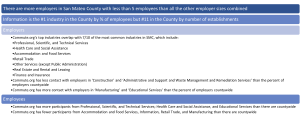
Industry Key Findings
Source: 2023 ECNVY Business Patterns County Business Patterns